Introduction
The equation uses the language of linear combinations.
The vector is a combination of the columns of A. The equation is asking for a combination that produces b. The solution vector comes at three levels and all are important:
- Direct solution to find by forward elimination and back substitution.
- Matrix solution using the inverse matrix: (If has an inverse).
- Particular solution (to ) plus nullspace solution (to ).
Direct elimination is the most frequently used algorithm in scientific computing. the matrix becomes triangular, then solutions come quickly.
Introduction to Vectors
Linear algebra is based around vectors. For two vectors and , if we add them, we get . If we multiply them by numbers and , we get and .
Combining this two operations (adding to ) gives the linear combination .
Example of a Linear Combination:
Then:
is the combination with .
Vectors and Linear Combinations
- is a typical linear combination of the vectors and .
- For and that combination is
- The vector goes across to and up to in the plane.
- The combinations fill the whole plane. they produce every .
- The combinations fill a plane in space. Same plane for
- But has no solution because its right side is not on that plane.
Two separate numbers and produce a two-dimensional vector :
Column vector = first component of = second component of
Vector Addition
and add to
The components stays separated of the components.
Subtraction follows the same principle.
Scalar Multiplication
The components of are and . The number is called a scalar.
, but 0 is not the number zero, its the Vector 0. The vector 0 has components 0 and 0.
There are four linear combinations: sum, difference, zero and scalar multiple:
- sum of vectors
- difference of vectors
- zero vector
- vector in the direction of
Visual representation of vectors
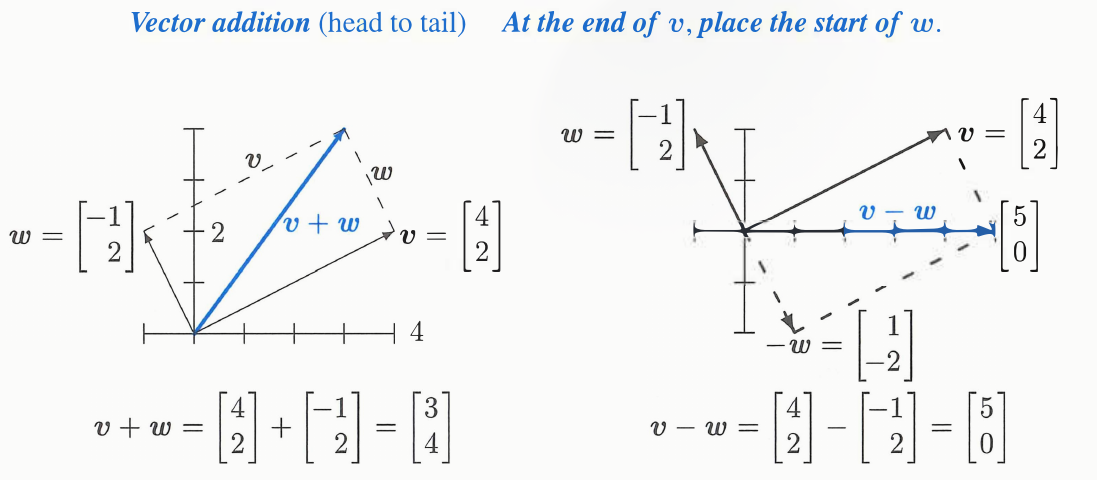 Vector addition produces the diagonal of a parallelogram.
We travel along and then along . This means .
Three Dimensional Vectors
A vector with two components corresponds to a point in the plane. The arrow ends at and starts from .
In 3D spaces, the plane is replaced by the three dimensional space.
1 \\ 1 \\ -1 \end{bmatrix} \text{ and } w = \begin{bmatrix} 2 \\ 3 \\ 4 \end{bmatrix} \text{ and }v+w=\begin{bmatrix} 3 \\ 4 \\ 3 \end{bmatrix}$$ The vector $v$ corresponds to an arrow in 3-space. ![[Linear Algebra-1777929856834.png|@darkmode]] Vectors $\begin{bmatrix}x \\ y\end{bmatrix} \text{ and } \begin{bmatrix}x \\ y \\ z\end{bmatrix}$ correspond to points $(x, y)$ and $(x,y,z)$. >Notation: $v=\begin{bmatrix}1 \\ 1 \\ -1\end{bmatrix} \text{ is also written as } v=(1,1,-1)$ **Notice:** $v$ is not a **row vector**. It's a **column** vector written in a easier way. In three dimensions, $v+w$ is still a component: $$v_{1} + w_{1} \text{ and }v_{2}+w_{2} \text{ and }v_{3}+w_{3}$$ **This works for n dimensions:** $$v_{1} + w_{1} \text{ and }v_{2}+w_{2} \text{ ... and }v_{n} + w_{n}$$ ## Lines, Planes and Spaces ### Lines A line [[#subspaces|subspace]] is a one-dimensional subspace spanned by vectors that are scalar multiples of a single vector. $$L = \{cv \mid c \text{ in }\mathbb{R}\}, v \neq 0$$ ### Planes A plane subspace is a two-dimensional subspace spanned by two linearly independent vectors. Equivalently, it consists of all linear combinations of those vectors. $$P = \{cv+dw \mid c,d \text{ in } \mathbb{R}\},\ v, d \text{ linearly independent}$$ ### Spaces A space subspace is a $k$-dimensional subspace spanned by $k$ linearly independent vectors. Equivalently, it consists of all linear combinations of those vectors.$$S = \{ c_1 v_1 + c_2 v_2 + \cdots + c_k v_k \mid c_1, \dots, c_k \in \mathbb{R} \}, \quad v_1, \dots, v_k \text{ linearly independent}$$ See [[Problem Set 1.1]]. ### Component sum When you take any linear combination $cv +dw$: $$\text{(first component) + (second component) + (third component)}$$ If every vector in a set has certain linear combination of its coordinates equal to zero, then **every linear combination** of them will also have that property. ### Spaces and Linear Combinations When a vector $w$ can be written as a [[Linear Combination]] $w = c u + d v$, it means $w$ belongs to the **span** of $u$ and $v$: the set of all possible combinations $c u + d v$. If $u$ and $v$ are not parallel (i.e., they are [[Linear Independence]]), their span is a **plane through the origin** in 3D space. Since $u$ and $v$ themselves obviously lie in that plane (by choosing $(c,d) = (1,0)$ or $(0,1)$), adding $w$, which is just another combination, means all three vectors are confined to that same plane. Graphically, you can think of $u$ and $v$ as two arrows defining a flat sheet through the origin; any weighted sum of them stays on that sheet. Thus, the condition "$w$ is a linear combination of $u$ and $v$" is exactly the algebraic test for [[Coplanarity]] (through the origin), assuming $u$ and $v$ are not [[Collinearity|collinear]]. If $u$ and $v$ were parallel, the span would be just a line, not a plane, but then $u$, $v$, and $w$ would all lie on that line instead. ## Lengths and Dot Products 1. The "dot product" of $v = \begin{bmatrix} 1 \\ 2 \end{bmatrix}$ and $w = \begin{bmatrix} 4 \\ 5 \end{bmatrix}$ is $v \cdot w = (1)(4) + (2)(5) = 4 + 10 = 14$. 2. $v = \begin{bmatrix} 1 \\ 3 \\ 2 \end{bmatrix}$ and $w = \begin{bmatrix} 4 \\ -4 \\ 4 \end{bmatrix}$ are perpendicular because $v \cdot w$ is zero: $(1)(4) + (3)(-4) + (2)(4) = 4 + -12 + 8 = 0$. 3. The length squared of $v = \begin{bmatrix} 1 \\ 3 \\ 2 \end{bmatrix}$ is $v \cdot v = 1^2 + 3^2 + 2^2 = 1 + 9 + 4 = 14$. The length is $\|v\| = \sqrt{14}$. 4. Then $u = \frac{v}{\|v\|} = \frac{1}{\sqrt{14}} \begin{bmatrix} 1 \\ 3 \\ 2 \end{bmatrix}$ has length $\|u\| = 1$. Check: $\frac{1}{14} + \frac{9}{14} + \frac{4}{14} = \frac{14}{14} = 1$. 5. The angle $\theta$ between $v$ and $w$ has $\cos\theta = \frac{v \cdot w}{\|v\| \|w\|}$. 6. The angle between $\begin{bmatrix} 1 \\ 0 \end{bmatrix}$ and $\begin{bmatrix} 1 \\ 1 \end{bmatrix}$ has $\cos\theta = \frac{1}{\sqrt{2} \cdot 1} = \frac{1}{\sqrt{2}}$. That angle is $\theta = 45^\circ$. 7. All angles have $|\cos\theta| \le 1$. So all vectors have $|v \cdot w| \le \|v\| \|w\|$ ([[Cauchy–Schwarz inequality]]). ### Inner Product [[Inner product]], also called **dot product**, of $v = (v_{1}, v_{2})$ and $w = (w_{1}, w_{2})$ is the number $v \cdot w$: $$v \cdot w = v_{1}w_{1} + v_{2}w_{2}$$ If the **dot product** of two vectors equals **0**, it means that those two vectors are **perpendicular.** The angle between them is 90º. $$v \cdot w = w \cdot v$$ ##### Example We have three goods to buy and sell. Their prices are $(p1,p2,p3)$ for each unit-this is the "price **vector**" $p$. The quantities we buy or sell are $(q1,q2,q3)$, positive when we sell, negative when we buy. Selling $q1$ units at the price $p1$ brings in $q1p1$. The total income (quantities $q$ times prices $p$) is the dot product $q ·p$ in three dimensions: $$Income = (qi,q2,q3) · (p1,P2,p3) = q1p1 + q2p2 + q3p3 = \text{dot product}$$ A **zero dot product** means that "the books balance". Total sales equal total purchases if $q · p = 0$. Then $p$ is perpendicular to $q$ (in three-dimensional space). A supermarket with thousands of goods goes quickly into high dimensions. **Important** For $v · w$, multiply each $v_{i}$ times $w_{i}$. Then $v · w = v_{1} w_{1} + · · · + v_{n}w_{n}$. ### Length The dot product of a **vector with itself** gives the length squared: $$||v||² = \begin{bmatrix} 1 \\ 2 \\ 3 \\ \end{bmatrix} \cdot \begin{bmatrix} 1 \\ 2 \\ 3 \end{bmatrix} = 1 + + 9 = 14$$ Because $v$ is not perpendicular to itself, the answer is not 0. The **length** $||v||$ of a vector $v$ is the square root of $v \cdot v$: $$\text{length} = ||v|| = \sqrt{ v \cdot v } = (v_{1}² + v_{2}² + \dots + v_{n}²)^{1/2}$$ ### Unit vector The word "unit" is always indicating that some measurement equals "one". The unit price is the price for one item. A unit cube has sides of length one. A unit circle is a circle with radius one. Now we see the meaning of a "unit vector". $$\text{A unit vector }u \text{ is a vector whose length equals one. Then }u \cdot u = 1$$ **Definition**: $u = v / ||v||$ is a **unit vector in the same direction as $v$**. ### The Angle between two Vectors Perpendicular vectors have $v \cdot w = 0$. The dot product is 0 **when the angle is 90º**. So: $$\text{The dot product is } v \cdot w = 0 \text{ when }v \text{ is perpendicular to }w$$ #### Proof When $v$ and $w$ are perpendicular, they form two sides of a **right triangle**. The **third side** is $v - w$ (the **hypotenuse** of the triangle) The [[Pythagoras Law]] for the sides of a right triangle is $a^2 + b² = c²$: **Perpendicular vectors**: $||v||² + ||w||² = ||v - w||²$ Writing out the formulas for those lengths in two dimensions, this equation is: $$(v_{1}² + c_{2}²)+(w_{1}²+w_{2}²)=(v_{1}-w_{1})²+(v_{2}-w_{2})²$$ The right side begins with $v_{1}² - 2v_{1}w_{1} + w_{1}²$. Then, $v_{1}²$ and $w_{1}^2$ are on both sides of the equation and they cancel, leaving $-2v_{1}w_{1}$. Also $v_{2}²$ and $w_{2}^2$ cancel, leaving $-2v_{2}w_{2}$. Now, divide by $-2$ to see $v - w = 0$: $$ 0 = -2 v _{1}w_{1} \text{ which leads to } v _{1}w_{1}+v _{2}w_{2} = 0$$ **Conclusion**: Right angles produce $v \cdot w = 0$. The **dot product** is zero when the angle $\theta = 90º$. Then $\cos \theta = 0$. The zero vector $v=0$ is perpendicular to every vector $w$ because $0 \cdot w$ is always zero. #### Properties If the **dot product** $v \cdot w = 0$ then the angle is $90º$. If the dot product is **positive**, then the angle $\theta$ is $\theta < 90$. If the dot product is **negative**, then the angle $\theta$ is $\theta > 90$. ![[Linear Algebra-1779056249818.png | @darkmode]]